
Mahogany Trees: Build a Hardwood Supply You Can Replant
Reserve Mahogany Seeds, use Tree Fertilizer without promising a fixed harvest date, and balance plantation space with daily hardwood trips.
On this page
Save the first Mahogany Seeds you find and plant a small patch before the next Hardwood project is urgent. A plantation supplies future harvests; it cannot guarantee the materials for a building you want to order tomorrow.
Find the first seeds
Mahogany Seeds can come from chopping Large Stumps or Large Logs, killing Secret Woods Slimes, and shaking or chopping established Mahogany Trees. Those are chances, not one seed guaranteed per stump. Later, the Island Trader exchanges one Stingray for a seed. From 1.6.6, the Raccoon Wife also offers a twenty-Coal exchange after four requests.
For an early supply, combine seed attempts with the Secret Woods Hardwood route. You still get the stump materials when no seed appears. That makes the outing useful while the plantation is only beginning.
Do not sell the seed just because the item has a visible sale value. If you have no established Mahogany Trees, planting it creates a different opportunity from shipping one more small item.
Six planting positions with room to walk
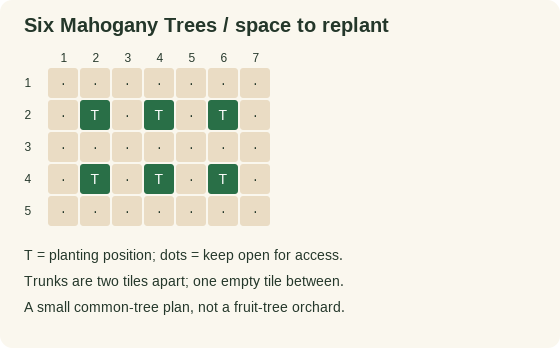
In this original example, plant at (2,2), (4,2), (6,2), (2,4), (4,4), and (6,4). Keep the intervening tiles open for growth and collection. This uses common-tree spacing rather than the larger fruit-tree orchard arrangement.
Before planting, clear the area and choose a permanent approach from the farm path. After harvesting, return a seed to the same marked position so the patch remains easy to count. A path or sign outside the planting positions can help distinguish this group from trees you intend to clear for ordinary Wood.
Fertilizer improves chances, not a deadline
An unfertilized seed has a fifteen-percent nightly chance to advance; Tree Fertilizer raises it to sixty percent and allows fertilized growth during Winter. The Mahogany Tree reference documents the growth and chopping yield.
Those probabilities explain why six trees planted together can mature on different days. Apply Tree Fertilizer when you have it and want the supply sooner, but count mature trees rather than assuming the entire patch will be ready after a fixed week.
A chopped tree gives a variable 8–13 Hardwood. At that documented range, six completed harvests would supply 48–78 Hardwood, before relevant profession effects. That is a range calculation, not a promise about the next six trees. Budget a time-sensitive purchase using materials already in storage.
Keep the next planting alive
Before chopping the last established tree, check your seed reserve. Shaking mature trees can supply additional seed opportunities, so retaining one while new plantings establish may be useful. Once replacement seeds are available, harvest the mature positions you need and replant.
A simple staggered plan is to plant three positions first and the other three when the next seeds arrive. It gives the patch two age groups without requiring a complicated calendar. If every tree is harvested together, expect a period with no mature supply while the next generation grows.
Reserve Hardwood by the next recipe
Put the building or machine requirement aside before spending the remainder. Six immature trees should not be counted as finished boat-repair materials. Keep gathering from established sources while the new patch develops.
Tapping Mahogany produces Sap, not Hardwood. If Hardwood is the goal, do not install tappers expecting a recurring Hardwood output. Use a separate tapper grove for Resin, Syrup, and Tar, and the farm layout guide for keeping these production areas out of daily travel paths.
Keep growth fertilizer separate from crop treatment
Tree Fertilizer goes on a planted wild-tree seed or sapling. It does not replace the quality or speed fertilizer used in tilled crop soil, and it does not accelerate fruit trees or Tea Bushes. Its recipe unlocks at Foraging 7 and uses five Fiber plus five Stone per application.
For the six-tree example, six applications therefore cost 30 Fiber and 30 Stone. Check whether that shared Fiber is already assigned to another recipe before fertilizing the full patch. The Tree Fertilizer reference also explains Mahogany’s probabilistic growth exception, so do not assign the exact timing of an ordinary fertilized oak to this grove.
Review: 25 October 2026. Sources above describe unmodded 1.6; the Raccoon exchange specifically needs 1.6.6 or later. The six-tree totals use the documented yield range.
Include the passage, game version, and platform so we can check it.